
American-built HF verticals
About GAP
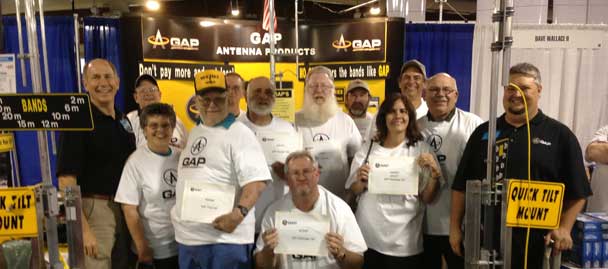
For 38 years, GAP Antenna Products has built HF vertical antennas that do one thing differently: get the feed up off the ground and let the design do the work. No radials to bury. No traps. No tuner. Just get on the air.
Let’s look at antenna technology realistically
For many years there were no real advances in vertical technology, a vertical wire, fed at the base, surrounded by radial wires. To operate multiband, traps were placed to shorten the antenna to a quarter wave on various bands. Manufacturers extolled their “low loss” trap designs, implying their antenna would outperform the others. Yet the big signals on the band did not come from these verticals, and consistent DX contacts did not happen.
The vertical became a second-class citizen, used by those with little space, minimal finances, or a need to comply with local restrictions. Ask a new ham what antenna to put up, and the common answer was “put up a dipole.” Why? Because a conventional vertical is the most inefficient, noisy antenna available for amateur use, and the trap version is worse.
Where does the power go?
Take a 26-foot vertical on 80 meters, which should be 66 feet high. The missing 40 feet is replaced by a coil (trap). This short antenna has a radiation resistance of about 4 ohms. But that isn’t the only resistor in the system. The significant one is earth loss, a function of the radials and ground. With three radials, earth loss can exceed 30 ohms.
Now you have 4 ohms that radiate and 30 ohms that warm the ground, for a total of 34. Only 4 ohms actually radiate. Feed that antenna 100 watts and only about 12 watts is radiated. Add lossy traps and it drops further. It is the huge earth loss that really matters, and GAP technology conquers it with an elevated feed.
Standard on every GAP antenna
Four reasons to avoid traps
- A trap is a coil-capacitor device operating at high voltage. High voltage in a moist environment is prone to arc and destroy itself.
- The coil changes value with temperature, shifting the antenna’s operating frequency.
- A trap must have a high Q to perform efficiently, but a high-Q trap has narrow bandwidth and restricts the antenna’s bandwidth.
- Traps are lossy. They rob transmitter power.
Based in Fellsmere, Florida
GAP Antenna Products is American-owned and American-built, serving the amateur radio community for 38 years. Thousands of GAP antennas are in use around the world, from backyards to DXpeditions.